Myopia control for kids — slowing nearsightedness before it gets serious.
My Eye Consultants offers an evidence-based myopia control program for school-age children — including FDA-approved soft contact lenses, prescription eye drops, and axial length tracking on the Zeiss IOLMaster 500. Orthokeratology is co-managed with a trusted local specialist. Led by Dr. Andrew N. Lu, OD, serving Chandler, Gilbert, Mesa, Tempe, and the East Valley.
Did your child’s prescription get stronger again this year?
Back-to-school exams are when most parents first notice it. A number that moves every year is worth looking at now — the earlier myopia control starts, the more of the progression it can prevent.
Myopia — or nearsightedness — is a refractive error where distant objects appear blurry while close-up vision remains clear. It happens when the eyeball grows slightly too long, causing light to focus in front of the retina instead of directly on it.
In children, myopia often progresses year over year as the eye continues to grow. A small prescription at age 8 can become a much higher one by age 14 — and the higher a child's final prescription becomes, the higher their lifetime risk of serious eye conditions later in life.
The encouraging news: research over the past two decades has produced effective ways to slow that progression. Myopia control isn't a cure — it's a strategy to reduce how much a child's vision worsens during their critical growth years, protecting their long-term eye health.
Why It Matters
High myopia carries lifelong risks.
It's not just about thicker glasses. Adults with high myopia carry a meaningfully higher lifetime risk of three serious eye conditions — risks that scale with how nearsighted the person eventually becomes.
01
Retinal Detachment
A medical emergency that can cause permanent vision loss. The risk is significantly elevated in adults with moderate-to-high myopia, particularly later in life.
02
Glaucoma
A progressive optic nerve disease that can cause irreversible vision loss. Higher myopia is associated with elevated lifetime risk of developing glaucoma.
03
Myopic Macular Degeneration
Damage to the central retina that's directly caused by the elongated shape of a highly myopic eye. A leading cause of vision impairment in adults with high myopia.
Slowing a child's myopia progression today is, in real terms, an investment in their eye health for the next 60 years.
Who It's For
Is myopia control right for your child?
Our myopia control program is best suited for school-age children who fit one or more of the following profiles.
Showing measurable progression
Children whose prescription has increased year-over-year — often by 0.50 diopters or more in a single year — are strong candidates for intervention.
One or both parents are nearsighted
Myopia has a strong genetic component. Children of myopic parents carry significantly higher risk and benefit from earlier monitoring.
Early onset of myopia (age 6–9)
The younger a child develops myopia, the higher their final adult prescription is likely to be without intervention. Early treatment has the largest impact.
Lifestyle risk factors
Limited outdoor time, extensive near work or screen exposure, and long study hours are all associated with faster myopia progression in growing children.
Check the Numbers
Is your child’s prescription changing faster than it should?
Most parents are handed a new number once a year and have no way to tell whether it is normal drift or something moving fast. If you have last year’s prescription and this year’s, this will do the arithmetic and tell you what the rate means.
Use the sphere — the first number on the prescription, the one that begins with a minus sign. It may be written as SPH, or just appear first. Do not use the cylinder (CYL) value, which measures astigmatism and is a different thing entirely. If the two eyes differ, use the stronger one. This is arithmetic and a reference range, not a diagnosis.
This calculation does not diagnose anything and does not replace an eye exam. Progression rates vary with age, and a single year is a short window to judge by. Bring both prescriptions to your visit — and if you have older ones, bring those too. The trend over several years tells us far more than any two points.
Treatment Options
Evidence-based approaches. One tailored plan.
Each treatment works differently. We select the best fit for your child based on their age, prescription, lifestyle, and progression rate — reviewing all options openly at the initial consultation, including those we co-manage with trusted specialists.
FDA-Approved Option Available
Soft Contact Lenses
Daily Disposable, Worn During the Day
Purpose-designed soft contact lenses use dual-focus optics to correct distance vision while signalling the eye to slow further elongation. There is now an FDA-approved daily disposable lens indicated specifically for slowing myopia progression in children, and Dr. Lu will discuss which lens suits your child at the consultation. Worn during the day, removed and discarded each evening — no overnight wear, no cleaning routine.
Best for: Active kids age 8+ ready to wear daytime contacts
Wear pattern: Daily disposable, removed at bedtime
Daily routine: One fresh pair each morning, no cleaning
Why parents like it: Lowest learning curve of any contact option
Co-Managed Referral
Orthokeratology (Ortho-K)
Overnight Corneal Reshaping Lenses
Ortho-K lenses are rigid gas-permeable contacts worn only at night, while the child sleeps. They gently reshape the front surface of the cornea so the child wakes up with clear vision — no glasses or contacts needed during the day. Research supports significant slowing of axial length growth. Ortho-K fittings are performed by a trusted local specialist we work with directly — Dr. Lu coordinates the referral and continues to track your child's axial length and progression here.
Best for: Active kids who don't want daytime correction
Wear pattern: Overnight only, 6–8 hours of sleep
Daily routine: Lens cleaning each morning, careful storage
Why parents like it: Total daytime freedom for sports and activities
How it works here: Fitted by our referral partner, monitored by Dr. Lu
Pharmacological
Prescription Eye Drops
Once Nightly, Alongside Glasses
A nightly prescription eye drop, used at a much lower concentration than the traditional formulation, has been shown across extensive clinical research to meaningfully slow myopia progression in many children. The low concentration is chosen deliberately to limit side effects while preserving the myopia-slowing effect. Dr. Lu will go over concentration, sourcing, and what to expect at the consultation.
Best for: Kids not ready for contact lenses; younger children
Wear pattern: Glasses still worn during the day
Daily routine: One drop per eye, at bedtime
Why parents like it: Easiest routine; works alongside glasses
Specialty Soft Contacts
Multifocal Contact Lenses
Off-Label Specialty Soft Lenses
For children whose age or prescription falls outside the range of the purpose-designed lenses, specialty multifocal soft contact lenses can be fitted off-label using a similar dual-focus design philosophy. These are particularly useful for children with stronger or unusual prescriptions, or where a more customised lens is needed.
Best for: Kids outside the standard prescription range
Wear pattern: Daily wear, removed at bedtime
Daily routine: Standard contact lens hygiene
Why parents like it: Flexible options when a standard lens isn't a fit
How The Program Works
A clear path from first visit to long-term care.
Myopia control is an ongoing program, not a single treatment. Here's what families can expect from the first consultation through the years of monitoring.
1
Initial Consultation
Comprehensive eye exam with cycloplegic refraction, autorefraction, corneal topography, and baseline axial length on the Zeiss IOLMaster 500 — plus family history review and a candid discussion of treatment options. Typically 60–90 minutes.
2
Treatment Selection
Dr. Andrew reviews each modality with the family, including pros, cons, and cost transparency. The right choice depends on your child's age, prescription, and lifestyle.
3
Progress Monitoring
Follow-up depends on how fast the myopia is moving: annually for mild myopia under -3.00 D, every six months above that. Each visit measures axial length, checks refraction, and examines the retina, front of the eye, and eye pressure.
4
Annual Re-Evaluation
A full annual review of progression trajectory and treatment effectiveness. Adjustments are made as your child grows.
Your Provider
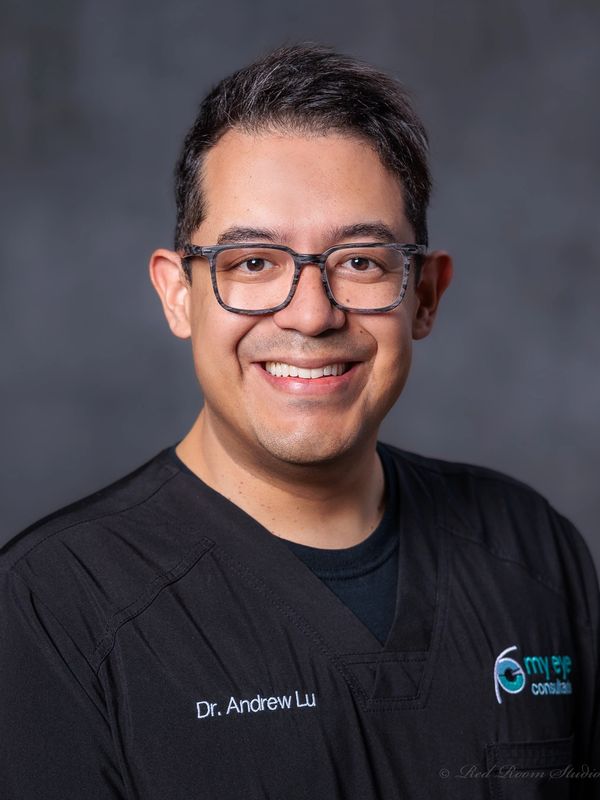
Dr. Andrew N. Lu, O.D.
Doctor of Optometry · Founder, My Eye Consultants
Dr. Andrew Lu leads myopia management for My Eye Consultants, bringing a thoughtful, family-first approach to pediatric eye care. A graduate of Midwestern University in Glendale, he has practiced in medical eye care throughout his career, and believes the best childhood eye care addresses both today's prescription and tomorrow's risk.
Dr. Lu approaches every child with patience and care — real explanations, an unhurried pace, and a long-term plan for protecting their vision through adulthood.
Doctor of Optometry — Midwestern University, Glendale AZ
Career-long practice in medical eye care
Special interest in pediatric and neuro-optometry
Fluent in English & Spanish
Member, American Optometric Association
For Pediatricians & Referring Physicians
Referring a child for myopia evaluation
We accept referrals from pediatricians, family physicians, and school nurses across the East Valley. The most common reasons are a failed vision screening at a well-child visit, a parent reporting that glasses stopped working sooner than expected, or a prescription that has moved more than about 0.50 diopters in a year.
Baseline axial length is measured on the Zeiss IOLMaster 500 at the first visit, which gives an objective growth measurement rather than relying on refraction alone. You receive a consultation report with findings and the treatment plan within three business days, and the child stays under your care for everything else.
Fax referrals to (480) 207-1551 or call (480) 590-0505. More detail and a downloadable referral form at For Referring Physicians.
Frequently Asked Questions
Real answers to real parent questions.
At what age should myopia control treatment start?
Myopia control is most effective when started early, during the school years, while the eye is still developing. Earlier intervention generally produces stronger slowing effects — but older children still benefit, and we evaluate every child individually based on their progression rate and family history. My Eye Consultants sees patients of all ages.
How effective are myopia control treatments?
Clinical research supports meaningful slowing of myopia progression with each of the primary treatments — soft contact lenses for myopia control (including an FDA-approved option for myopia control in children), low-concentration prescription eye drops eye drops, specialty multifocal lenses, and orthokeratology, which we co-manage with a local specialist. The right choice depends on your child's age, lifestyle, and prescription. Dr. Andrew Lu reviews the evidence-based options at the initial consultation.
Is myopia control covered by insurance?
Most vision insurance plans cover the comprehensive eye exam portion of myopia control. However, specialty contact lenses (myopia control lenses, Ortho-K) and prescription eye drops are typically not fully covered and are considered cash-pay services. We discuss costs transparently at the initial consultation so families can make informed decisions for their child and their budget.
Are contact lenses safe for young children?
Yes. Research shows that children as young as 8 can safely and successfully wear daily disposable contact lenses like purpose-designed soft contact lenses. Orthokeratology lenses, worn only at night, are also well-tolerated by children when properly fitted and monitored. Safety depends on proper hygiene, fit, and follow-up care — all of which are core to our program.
How are myopia control contact lenses different from regular contact lenses?
Purpose-designed soft contact lenses are specifically designed with dual-focus optics that not only correct your child's nearsightedness but also send signals to the eye that may slow further progression. Regular contact lenses only correct vision — they do not slow myopia progression. purpose-designed soft lenses is currently the only soft contact lens with FDA approval for myopia control in children.
How long does myopia control treatment last?
Most children stay in active myopia control treatment until their late teens, when the eye stops growing and myopia progression naturally slows. The duration depends on the child's individual progression rate, treatment response, and growth patterns. Follow-up runs annually for mild myopia under -3.00 D and every six months above that, with a full comprehensive evaluation each year throughout treatment.
Can my child do myopia control if their prescription is already high?
Yes. While earlier intervention typically produces the best outcomes, children with higher prescriptions still benefit meaningfully from slowing further progression. Reducing the long-term risk of eye disease associated with high myopia — including retinal detachment, glaucoma, and macular degeneration — remains a valuable goal even when the starting prescription is significant.
What happens at the first myopia control appointment?
The initial consultation includes a comprehensive eye exam, baseline measurements (cycloplegic refraction, axial length on the Zeiss IOLMaster 500, corneal topography, retinal examination and eye pressure), a review of progression patterns, and a discussion of treatment options tailored to your child. We explain the pros and cons of each modality and recommend the best fit. The appointment typically lasts 60 to 90 minutes.
Protect your child's vision today — for the next sixty years.
Schedule a myopia control consultation at My Eye Consultants in Chandler. We'll evaluate where your child is, where they're headed, and what we can do about it together.